

Projects and Infrastructure
| Project Name | Years Active |
|---|---|
|
CANISCurated AI-ready Network telescope datasets for Internet Security
AI models trained on UCSD Network Telescope data depend on the integrity and provenance of that data, but emerging risks and operational hurdles threaten data quality.
CANIS is a suite of modules to transform the applicability of UCSD-NT in AI contexts.
|
2025 - 2028Active |
|
NIDSNetwork Infrastructure Data Science
Cybersecurity education lacks hands-on training with real-world network datasets, leaving students without practical skills to analyze and respond to modern threats.
NIDS provides cyberinfrastructure-ready, data-driven cybersecurity training resources using real-world datasets, enabling educators to run hands-on network security courses.
Faculty: Teach a Course with NIDS
When you adopt a NIDS module in your own course, your students work with real CAIDA network measurement data instead of toy datasets. Each module pairs a curated dataset with exercises, analysis notebooks, and an instructor guide, and runs on the National Research Platform, so there is nothing for students to install. |
2025 - 2028Active |
|
ESCALATEEngaging Scholars in Cybersecurity Analysis: A Laboratory for Teaching and Education
Cybersecurity education often relies on synthetic or outdated examples, leaving students and early-career researchers without hands-on exposure to the real-world datasets and cyberinfrastructure workflows needed to confront today’s threats.
The ESCALATE project will develop a centralized cybersecurity community hub that provides cyberinfrastructure-ready, data-driven cybersecurity training resources using real-world datasets.

|
2025 - 2028Active |
|
ROOTBEERRouting Operations Observational Technology: Building to Enable Education and Research
Route leaks, hijacks, and other BGP anomalies regularly disrupt U.S. research and education networks, yet operators lack real-time, actionable visibility into routing events that threaten the security and resilience of this critical infrastructure.
The ROOTBEER project will build a routing observatory and operational dashboard to detect route leaks and improve the security and resilience of U.S. research and education network infrastructure.
How You Can Help
When R&E network operators use ROOTBEER's free routing tools, including RPKI ROA and ASPA planners, an IRR AS-SET builder, RPKI coverage visualizers, and a daily Global LPP Report spanning 2,700+ autonomous systems, they strengthen the routing security and resilience of U.S. research and education infrastructure. As an experimental service, it improves with operator usage and feedback. |
2025 - 2028Active |
|
STARNOVAScalable Technology to Accelerate Research Network Operations Vulnerability Alerts
Scientific cyberinfrastructure faces escalating cyber threats, but operators lack rapid, data-driven warning systems to detect emerging attacks.
STARNOVA enhances the UCSD Network Telescope with real-time analytics to detect and alert on security threats targeting the San Diego Supercomputer Center’s resources.
|
2023 - 2026Archived |
|
AVOIDAutomated Verification Of Internet Data-paths for 5G
5G communications often traverse untrusted third-party infrastructure — including non-cooperative base stations and transit networks — exposing sensitive traffic to nation-state adversaries who can observe metadata, manipulate routing, or disrupt service even when payloads are encrypted.
AVOID is a system that automatically reroutes communications away from potentially adversary-controlled paths to verified safe routes, keeping 5G traffic on benign infrastructure.
|
2022 - Active |
|
RABBITSA Toolkit for Reproducible Assessment of Broadband Internet Topology and Speed
Broadband performance and topology measurements vary widely across tools and platforms, producing inconsistent results that complicate research comparisons, regulatory mapping, and broadband-policy decisions such as those driving current federal deployment programs.
The RABBITS project aims to develop a new measurement toolkit for assessing broadband internet topology and speed, enabling consistent and reproducible tests across platforms.
|
2023 - 2026Archived |
|
Cloud BottlenecksDetection and Analysis of Infrastructure Bottlenecks in a Cloud-Centric Internet
Cloud applications depend on infrastructure that extends beyond any single provider’s boundary, and performance bottlenecks in the middle and last mile increasingly degrade user experience. However, these external bottlenecks remain difficult to detect, attribute, and diagnose.
The Cloud Bottlenecks project proposes an effort to design measurement and analysis tools to reveal performance bottlenecks outside the cloud networks where the high cost of deployment and operations leads to infrastructure bottlenecks for cloud applications.
|
2022 - 2026Archived |
|
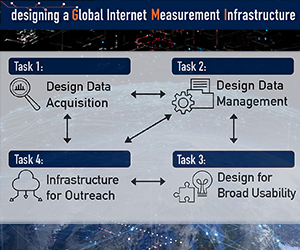
GMIDesigning a Global Measurement Infrastructure to Improve Internet Security
The Internet’s core infrastructure faces persistent threats such as route hijacks, DNS abuses, and certificate authority compromises, yet security research is hindered by the lack of comprehensive data needed to evaluate long-term defenses.
GMI is a design initiative to prototype a distributed, integrated Internet measurement infrastructure that supports broad data collection, curation, and sharing to improve Internet security and resilience.
|
2021 - 2025Archived |
|
STARDUSTSustainable Tools for Analysis and Research on Darknet Unsolicited Traffic
Measuring the Internet’s susceptibility to spoofed source address IP packets, we generate a summary report on the current “state” of Internet IP source address spoofing/filtering using data from an active measurement tool.
|
2017 - 2021Archived |
|
Spoofer
Many networks still allow packets with forged source IP addresses (IP spoofing), a long-standing vulnerability used to launch untraceable attacks.
Spoofer is an active measurement project that tests networks for susceptibility to spoofed IP packets and publishes reports on global deployment of source address validation.
How You Can Help
When you download and run the free Spoofer client on your network, your test results contribute to the only global measurement of source address validation (SAV) deployment, the practice that prevents spoofed-packet DDoS attacks. Operators, incident responders, and policymakers use these results to identify and remediate vulnerable networks. |
2015 - Active |
|
Cloudtrace
As cloud providers become central to the Internet ecosystem, it remains difficult to understand how their internal networks interconnect with the public Internet, limiting the ability to diagnose performance and resilience issues.
CloudTrace investigates how cloud networks interconnect and interact with the Internet by systematically probing routed IPv4 subnets to map cloud-to-Internet paths.
|
2020 - Active |
|
FANTAILFacilitating Advances in Network Topology Analysis
Researchers have amassed massive traceroute datasets, but the lack of scalable interfaces to explore raw path data prevents fully leveraging their scientific value.
FANTAIL provides an interactive platform for querying and analyzing large-scale Internet path measurement datasets, supporting deeper topology research.
|
2019 - 2025Archived |
|
KISMETKnowledge of Internet Structure: Measurement, Epistemology, and Technology
This page describes KISMET, a CAIDA project of the NSF Convergence Accelerator program.
|
2019 - 2020Archived |
|
MANICMeasurement and ANalysis of Internet Congestion
The MANIC project – Measurement and Analysis of Interdomain Congestion – has developed a prototype system to monitor interdomain links and their congestion state, in order to provide empirical grounding to debates related to interdomain congestion.
|
2017 - 2022Archived |
|
IODAInternet Outage Detection and Analysis
CAIDA developed an operational prototype system that monitors the Internet, in near-realtime, with the goal of identifying macroscopic Internet outages affecting the edge of the network, i.e., significantly impacting an AS or a large fraction of a country.
|
2012 - 2020Archived |
|
IMPACTInformation Marketplace for Policy and Analysis of Cyber-risk & Trust
The Information Marketplace for Policy and Analysis of Cyber-risk & Trust (IMPACT) project provides vetted researchers with current network operational data.
|
2012 - 2020Archived |
|
NDN-NPNamed Data Networking Next Phase
Named Data Networking is a proposed Internet architecture that replaces IP with a network layer that routes directly on content names.
|
2014 - 2017Archived |
|
IRNC-SPIRNC Special Project
The goal of this IRNC Special Project was to identify and support the measurement priorities of the International Research Network Connections community.
|
2010 - 2014Archived |
|
Network Telescope
Unsolicited and malicious Internet traffic often targets unused IP space, but most networks lack visibility into this activity, limiting understanding of global security events.
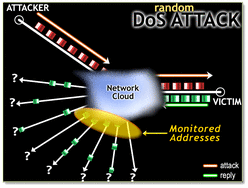
The UCSD Network Telescope passively monitors a large block of unused IPv4 address space to capture anomalous traffic and provide continuous data on global threat activity.
|
2012 - Active |
|
IPv6 Evolution
A measurement-driven exploration of the evolution of IPv6.
|
2012 - 2016Archived |
|
NDNNamed Data Networking
Named Data Networking is a proposed Internet architecture that replaces IP with a network layer that routes directly on content names.
|
2010 - 2014Archived |
|
Economics of Internet Interconnection
From 2010-2013, CAIDA performed a study of the economics of Internet interconnection.
|
2010 - 2013Archived |
|
CybersecurityCybersecurity
The Cybersecurity project proposes to develop and implement new measurement and data collection technologies to understand and protect essential U.S. informational infrastructure.
|
2012 - 2019Archived |
|
SD-NAPSan Diego Network Access Point
The purpose of the SD-NAP is to facilitate efficient interconnection of Internet Protocol transit networks within and to the San Diego Local Access and Transport Area, California LATA 6, and to provide a platform for traffic analysis by CAIDA researchers, with the goal of promoting a robust, scalable global Internet infrastructure.
|
1998 - 2000Archived |
|
DatCatInternet Measurement Data Catalog
The goal of the Trends project is to create and populate the Internet Measurement Data Catalog (IMDC) that will facilitate access, archiving, and long-term storage of Internet data as well as sharing the data among Internet researchers.
|
2002 - 2018Archived |
|
ITLInternet Teaching Laboratories
As an extension of the IEC project, CAIDA helped develop Internet Teaching Laboratory (ITL) facilities at several U.S. colleges and universities.
|
1998 - 2002Archived |
|
Internet Atlas
The Internet Atlas project involved developing techniques, software, and protocols for mapping the Internet, focusing on Internet topology, performance, workload, and routing data. It also includes assessment of state-of-the-art in this nascent sector.
|
1999 - 2004Archived |
|
IECInternet Engineering Curriculum Repository
The Internet Engineering Curriculum Repository is a projectto help educators and others interested in Internet technology keep up with developments in the field.
|
1998 - 2002Archived |
|
DNS AnalysisAnalysis of the DNS root and gTLD nameserver system
We conducted passive and active measurements of the DNS root servers behavior, connectivity and performance. We also analyzed data collected at the servers themselves.
|
2001 - 2002Archived |
|
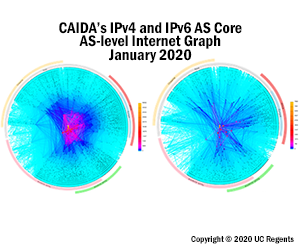
AS Core Visualization
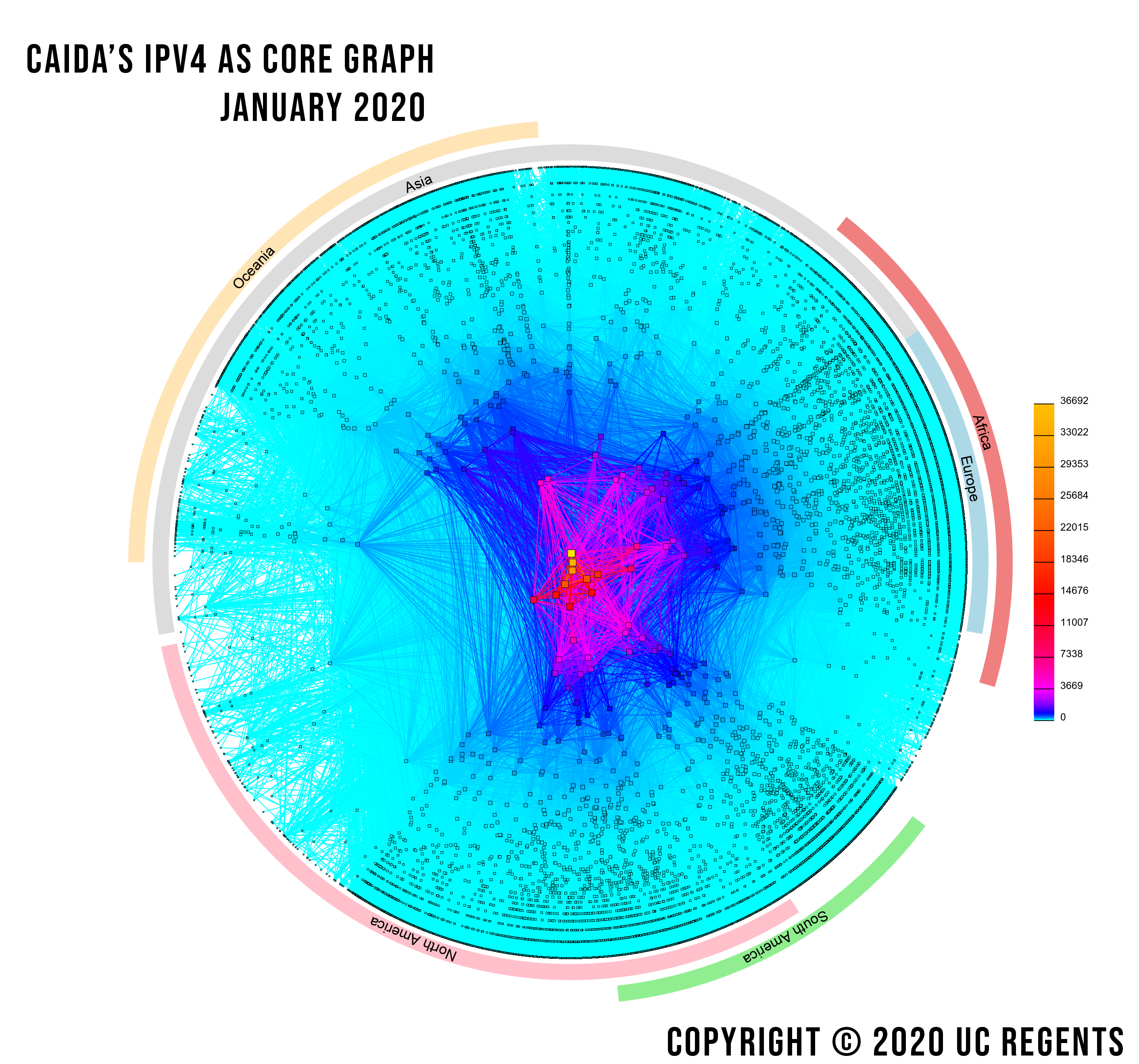
The Internet’s Autonomous System topology is continually reshaped by flattening, hypergiant consolidation, and divergent IPv4 and IPv6 interconnection patterns, making macroscopic visualization essential to track structural change over time.
AS Core Visualization generates annual AS-level Internet topology maps that visualize changes in IPv4 and IPv6 interconnection structures over time.
|
2003 - Active |
|
Macroscopic Topology Measurements
CAIDA researchers have been collecting connectivity and latency data for a wide cross-section of the commodity Internet since 1998 for the IPv4 address space and since 2003 for the IPv6 address space. We use these data to derive maps of the Internet at various granularity levels: IP, router, AS.
|
1998 - 2018Archived |
|
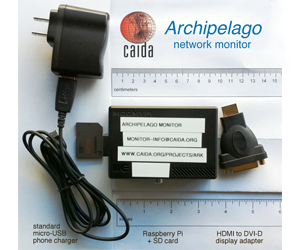
ArkArchipelago Measurement Infrastructure
Understanding the global Internet requires measurement from diverse vantage points, coordinated experimentation across sites, and continuity over years. Earlier-generation tools and ad hoc deployments cannot sustain these capabilities.
Ark is CAIDA’s next-generation, globally distributed active measurement infrastructure supporting coordinated experiments and long-term Internet topology mapping.
How You Can Help
When your network hosts a measurement node that participates in CAIDA's Archipelago (Ark) infrastructure, it broadens the view of the global Internet for the network research community. Network researchers use CAIDA topology data to conceive, develop, and test their models and methods. |
2006 - Active |
|
DITLA Day in the Life of the Internet
DITL is a product of the effort of CAIDA, ISC, DNS-OARC, many partnering root nameserver operators and other organizations to coordinate and conduct large-scale, simultaneous traffic data collection events with the goal of capturing datasets of strategic interest to researchers.
|
2002 - 2009Archived |
|
Bandwidth Estimation
We propose to improve existing techniques and tools for bandwidth estimation, and to test and integrate them into Department of Energy (DOE) and other network infrastructures. The proposed effort will overcome limitations of existing algorithms whose estimates degrade as the distance from the probing host increases.
|
2001 - 2004Archived |