

According to the Best Available Data

The CAIDA blog — commentary and analysis of Internet measurement, infrastructure, policy, and economics, published since 2006. Formerly hosted at blog.caida.org. See About the CAIDA Blog · Categories · All entries by month · RSS feed.

voiceofsandiego.org covers caida's recent work in Nature

As a follow-up to the recent press flurry about Dima's routing research, Voice of San Diego interviewed us for several hours last week, and no doubt spent twice that time focused on trying to get a complex story mostly right. Hyperbolic headlines notwithstanding, the journalist who interviewed us, David Washburn, did an outstanding job of fact-checking and making sure he accurately represented our views. If this is the future of journalism, I'm not the least bit worried about the death of 20th century journalism models. The real fourth estate is in good hands.

proposition: International Bureau of Internet Statistics

Last month I submitted two proposals to the National Cyber Leap Year call for input from the U.S. Networking Information Technology Research and Development (NITRD) Program. I submitted two ideas, the International Bureau of Internet Statistics, and Cooperative Measurement and Modeling of Open Networked Systems (COMMONS, a two-year old idea). The Bureau of Internet Statistics still strikes some as batty, but over the holidays I caught up on some panicky OECD state-of-malware-landscape papers on how uninformed we are and how little data we have, while the only concrete recommendation in the "ITU's study on the financial aspects of network security: malware and spam" report was

Although the financial aspects of malware and spam are increasingly documented, serious gaps and inconsistencies exist in the available information. This sketchy information base also complicates finding meaningful and effective responses. For this reason, more systematic efforts to gather more reliable information would be highly desirable.

In fact the only conclusions of that report seemed to be: "(1) We have no real data, so we have no idea what's really going on. (2) But things are still worse than ever, and they must be worse than we think (3) the United States is the biggest source of damage. (maybe)." It's a pretty unsettling report. You really do expect to read a proposal for a Bureau of Internet Statistics by the end of this paper, but the idea is pure fantasy for anyone who knows a moderate amount about how the Internet works. (hint: no data-sharing.) if Bagehot is right that the greatest pleasure in life is to do what people say you cannot do, some people should have a lot of fun building one.

in (re)search of scalable routing..

I've written before about the growing consensus among experts that the Internet's underlying communications routing algorithms are fundamentally unscalable, so I am delighted to have CAIDA's routing research group led by Dima Krioukov achieve some fundamental routing research results worth extensive media coverage. We have not solved the Internet's routing scalability problem, but these recent discoveries will help that cause.

After many revisions of earlier (much longer) drafts, and help from professional referees and editors, our study of how complex networks are naturally navigable (hint: it's their bizarrely non-random topological structure!) led to a publication in Nature (to paying subscribers, admittedly not the most efficient way of routing information, not to mention doing science, but Nature has to pay these expert editors somehow). I was reluctant to blog about it here since I can't link to the Nature version directly, but it's also too exciting not to tell you about! Curious non-subscribers can rely on the media coverage, find a friend with an .edu address, read the submitted draft, or email us asking for a copy.

an amazing trip talking IP in Santiago and Patagonia

In November 2008 I had the honor of being invited to speak at the Chilean Computer Science Society Annual Meeting, this year at the Universidad de Magallanes in Punta Arenas, Chile. I followed a colleague who has been visiting CAIDA for the last two years, Sebastian Castro, back to his sponsoring institution, NIC Chile. We started out with an interesting meeting with a core of technical folk where I learned about the activities of NIC Chile's recently established research arm (NIC Labs). We exchanged valuable information on the common (and less common) challenges of doing successful research in our respective environments.

Then we went over to Sebastian's alma mater, the computer science department of the Universidad de Chile, where we met with several engineering professors, many of whom spent graduate school and/or postdoc years abroad, including Alejandro Hevia who recently finished his PhD at UCSD (and who introduced me to Sebastian). It's a telling indicator that so many Chilean academics return to Chile after spending years abroad -- Santiago has a vibrant energy, "two-thirds European influence, one-third American", one researcher affectionately described the city. The relationship between the university and NIC Chile, which started out as a part of the university, is a healthy and illuminating example of a working public-private partnership in support of the Internet as critical infrastructure. We need more of them in my own country. I was particularly impressed with NIC Chile's interest in what it would take to: (1) get the DNS root signed; (2) advance naming, routing, and addressing security; (3) make the Internet safe for IPv6. Forward thinkers abound among Chilean academics.

After a whirlwhind taste of Santiago I gave a talk at NIC Chile's OpenNIC conference, and had lunch with several folks from Asociacion de Proveedores de Internet, a consortium of commercial ISPs in Chile, who asked me great questions about how the Internet, and Internet research, is evolving in the U.S. versus what we both knew of other countries. I gained even more appreciation for the fact that countries are watching each other and trying to learn from the successes and mistakes of others.

We then flew down to Punta Arenas, near the southern tip of Chile (Tierra del Fuego), where the next morning I gave the same talk at Chile's annual networking conference being held at the Universidad de Magallanes. After some site-seeing and fresh antarctic seafood (mmm.) in Punta Arenas, we rented an SUV, and took off (with husband and two parents who had been entertaining themselves thus far) for a few days of adventures in Patagonia, a phenomenally beautiful part of the planet. Sebastian and Tim carried the same stellar camera, and took pictures like I've never seen.

In the meantime, back home at UCSD, CAIDA's latest routing research results were being announced quite widely since they were about to be published in Nature (to paying subscribers). An earlier (much longer) version is available to Internet users. Definitely worth another essay.

the inevitable conflict between data privacy and science

Balancing individual privacy against other needs, such as national security, critical infrastructure protection, or even science, has long been a challenge for law enforcement, policymakers and scientists. It's good news when regulations prevent unauthorized people from examining the contents of your communications, but current privacy laws often make it hard -- sometimes impossible -- to provide academic researchers with data needed to scientifically study the Internet. Our critical dependence on the Internet has rapidly grown much stronger than our comprehension of its underlying structure, performance limits, dynamics, and evolution, and unfortunately current privacy law is part of the problem -- legal constraints intended to protect individual communications privacy also leave researchers and policymakers trying to analyze the global Internet ecosystem essentially in the dark. To make matters worse, the few data points suggest a dire picture, shedding doubt on the Internet's ability to sustain its role as the world's preferred communications substrate. In the meantime, Internet science struggles to make progress given much less available empirical data than most fields of scientific inquiry.

Supported by DHS's S&T Directorate, We investigated the state of the field of network traffic data anonymization in 2008, including: (1) augmenting our networking bibliography with a few dozen papers on various aspects of anonymization; (2) creating a taxonomy of tools for anonymizing Internet data and log files; (3) creating a summary of best practices for PREDICT researchers; and (4) working with Internet2 on establishing its own IRB for network research using Internet2 data.

I also moderated a panel in October 2008 on "Network Data Sharing Issues" at ACM's workshop on Network Data Anonymization. Immediately following another panel where lawyers from Europe, Japan, and the United States presented the data privacy laws of their respective jurisdictions, I coordinated a panel discussion of how researchers are navigating such legal issues (or not) in their scientific networking research. (I owe thanks to Christos Papadapolous who made my job much easier by arranging for a recording of a related panel (3 hour mp3 file) two weeks earlier at CCW, which we cited widely. Their extensive discussion made our panel significantly more productive than it would have been otherwise.)

The workshop group (about 30 people, lots of international representation) found rough consensus that two documents are needed, and several attendees from the workshop are already contributing to a draft of the first one.

  1. A proposed code of conduct for the network measurement community, per Mark and Vern's suggestion last year. A useful model is the 1979 Belmont report which propounded ethical principles and guidelines for the protection of human subjects of research. Applied to the Internet, such a report would ideally include a list of the most important questions for empirical Internet researchers to be studying this decade, and what specific data is needed to study them, but creating a list is a topic for another workshop we'll try in 2009. In the meantime, if you have a minute, CAIDA put up a Google moderator page soliciting the most important empirical questions to be asking about the Internet. (The obvious cybersecurity need for data is to test out intrusion/anomaly detection tools, which require some understanding of what "normal" traffic looks like. DHS's PREDICT project is trying to enable data sharing for such security research, but its main obstacles are legal issues too murky even for DHS to navigate.)
  2. Building a case for legislative change. All three attorneys in the earlier panel echoed Paul Ohm's comments at CCW (see 3 hour mp3 file above) that by the time Internet measurement-related legislation does land on Congressional radar (don't hold our breath, they warned) the network research community had better have a compelling story for what we want changed and why. Orin Kerr reminded us that the best cases for legislative change included numbers in units of dead bodies (hence FISA being rewritten at the blinding legislative speed of 16 months!), or billions of dollars (hard to measure when organizations are disincented to acknowledge their systems are vulnerable enough to cost them significantly).

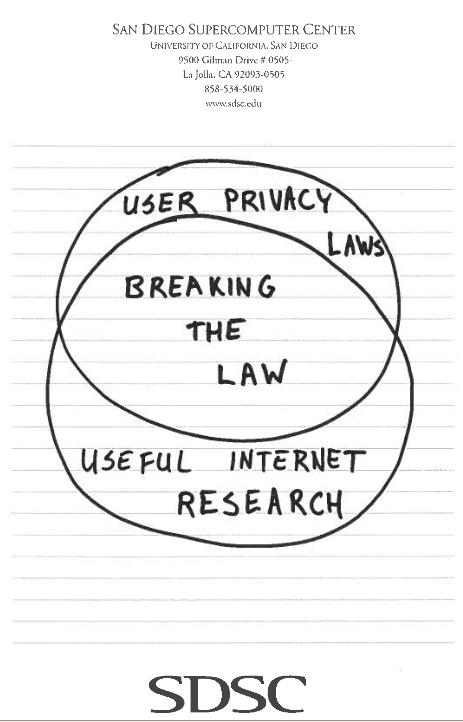
Inspired by the workshop and the Indexed blog, CAIDA data administrator and researcher Emile Aben scribbled the below view of current network research, suggesting how much more useful Internet research could be done than we're capable of doing at the moment.

I admit this issue gives me mixed feelings while watching EFF sue everyone they can find related to wiretapping undertaken as part of post-9/11 surveillance activities. As a scientist and idealist, I'm generally in favor of greater transparency when given a choice, so publication of what actually transpired is appealing. But, I have spent a decade of that scientific career gaining an appreciation for just how little situational awareness those agencies charged with infrastructure protection can possibly have regarding global Internet dynamics and operational threats. Like scientists, they are especially constrained if they follow the most conservative interpretations of laws written before the Internet was created, and certainly before it was a viable vector for economic, social, and even physical damage to humans. I find myself wishing EFF would worry less about how little time it takes for NSA to know what's happening on the Internet and more about how much time it takes for everyone else to know. Maybe now that FISA has congealed they can throw some effort into the policy work required to make the Internet a safe place to do science.

We first have to figure out what the word privacy means now, what we care about and why. We have to figure out what it is that this conception privacy is supposed to mean when we're all through. And then we have to figure out what we, collectively, mean to do about it. About my idea of privacy, there are services provided by Google which don't meet my idea of privacy. And I can't imagine receiving my mail there. But nobody has ever told me I had to receive my mail at Google. It's an opt-in interface. You bring them data, of yours, voluntarily, and you get pretty amazing new services connected with your data, in return for allowing them to keep any inference they can make by mining your data. If you think that's a fair bargain, you're free to accept. If you think it's not a fair bargain, you're free to decline. I have no problem with the bargain, most of the time I decline it, some of the time I accept it. Often I accept it with a vanilla wafer instead of a cookie, right? We have to manage our own idea about what constitutes privacy and autonomy in the 21st century. In order to do that we have to have accurate information. We have to know what people do, we have to have enough transparency to understand what they do, and we have to teach children about how to think about these issues as fundamental issues of ethics and morality in a technological society. I personally spend a lot of time on this, I teach privacy, I think about it, I write about it, I talk about it, I try to lawyer for it. But it is growing very difficult, because the net is pulling us together in ways that human beings have never been together before. And what we have thought of as "privacy", meaning exclusive control over our identity, is being shattered into a million pieces. And those pieces are flying in different directions, and even studying how it works is difficult, and most people don't do it. So the consequence is that what we have called privacy is dying before our eyes, and being replaced by something which is a mere facsimile. It's not Google's fault that this is true, it's not Microsoft's fault that this is true, it's not the Free Software Foundation's fault that this is true, and you can't blame it on the Internet, because the Internet is just all of us. But we have built a society which is transforming who we are, and like most other forms of ecological disaster, that happens to us mostly while we refuse to open our eyes to the evidence that it is going on. We're going to have to get very serious about this, very soon. I keep waiting, it keeps not happening.

Eben Moglen, http://en.wikisource.org/wiki/Freeing_the_Mind:_Free_Software_and_the_end_of_proprietary_culture

internet telemetry, v6

i gave a (faster, less understandable) version of this talk (pdf or slides+audio quicktime) at the October 2008 ARIN meeting in Los Angeles (original October version) and again to ISOC's advisory council meeting in November. motivation: the end of the current addressing architecture, with scant understanding of how to retain all its positive features in the face of inevitable change. a topic i worry about more each year.

(peter cincotti sings as if we knows what we're going through.)

another great meeting organized by DHS S&T

Busy month. On 15 October I presented CAIDA's analysis of the CAIDA/ARIN IPv6 survey at the ARIN meeting. More on that later.

The next day I presented to the DHS/SRI Infosec Technology Transition Council (ITTC), where "experts and leaders from the government, private, financial, IT, venture capitalist, and academia and science sectors come together to address the problem of identity theft and related criminal activity on the Internet."

It is only a three-hour meeting, a few times a year (my first time), but intense. They had a timely panel first, "Integrity in Elections", where they reviewed so many methodological flaws in voting procedures, they shed substantial doubt on the proposition of fair national elections anytime soon. John Sebes motivated the computational science challenge well: if we are not capable of building a trustworthy computational system to accomplish the conceptually simple task of tallying a vote, what can we expect to be capable of building trusted computational systems to do? And while there is inspirational work on documenting and proposing how to solve the technology issues that threaten election integrity, the bottom line is disheartening.

Then was my talk, "Internet Science: Why Wall Street and Main Street Should Care", a survey of CAIDA activities with emphasis on a recent DHS S&T funded project on Internet mapping. I posed questions we want to be able to pursue with our new active measurement infrastructure and why it's important to pursue them. I explained why I worry about Forbes Magazine using CAIDA's asrank tool as a definitive industrial ranking of Internet companies. I mentioned the IPv4 address space runout and our anguished response. Regarding lack of transparency, I drew a few comparisons between the Internet ecosystem and the financial ecosystem. I succeeded in making everyone uncomfortable. The only question there was time for at the end was from an attentive woman from DOD, "Well, wait a minute, how do things get better, what are we going to do about this mess?"

I didn't give a good answer, so I wanted to follow up. My list of things lawyers should know about the Internet covers how several communities are responding, and recommends several steps for moving forward. But the final speaker, Rod Beckstrom (new director of DHS's National Cybersecurity Center) pointed out (and represents) an important part of the solution, which applies not only to voting integrity and the Internet, but to other federally-regulated resources transformed by the Internet: education, spectrum, intellectual property.: there is a lot of heavy political lifting to be done. A big part of that lifting is educating government sufficiently about the Internet so they can set effective policies. And while the best talent remains in the private sector, slow progress will be made on opening channels of communication, because the private sector has only disincentives to open them.

Doug manages to open these channels (not to mention effect other change), by getting academic, industry, and government colleagues in a room every few months to informally discuss technical developments. Like Rod's decentralized peace network of CEO's -- as well as Rod's decision to come to DHS -- the ITTC illustrates how to be part of the solution rather than part of the problem.

All the notions we thought solid, all the values of civilized life, all that made for stability in international relations, all that made for regularity in the economy.. in a word, all that tended happily to limit the uncertainty of the morrow... all this seems badly compromised. I have consulted all the augurs I could find, of every species, and I have heard only vague words, contradictory prophecies, curiously feeble assurances. Never has humanity combined so much power with so much disorder, so much anxiety with so many playthings, so much knowledge with so much uncertainty. -- paul valery, historical fact

Internet2 launching its own "IRB"

I (and others) have spent a bit of time over the last year encouraging Internet2 to take a more proactive role in supporting network research. So I was delighted to see the proposal of a new network research review council, which I reckon will amount to a network-research-dedicated IRB for Internet2.For most researchers, Internet2 has the closest they will get to real large-scale network operators. Internet2 operators are more willing to expose pain points and obstacles they encounter, and Internet2 provides more data about itself to the public, than any other network I know, public or private. Even better, Internet2 management is also more capable of fostering effective, cross-disciplinary, scientific Internet research than the private sector, simply by virtue of their incentive structure.

And yet even Internet2 recognizes its data sharing limits, rooted in three obstacles: (1) user privacy concerns; (2) fear of lawsuits from hollywood over file-sharing activity or from commercial peers over non-disclosure-laden peering agreements; and (3) economics -- operational costs of storage, bandwidth and data management resources. As a result of these legitimate concerns, both operators and researchers in the community are unable to pursue a variety of questions -- including in the increasingly important area of network security -- due to economic and policy issues, rather than anything scientific or technical.

To protect individual privacy, Internet2's current method of anonymizing data is to zero out the lower 11 (of 32) bits of the IPv4 address in netflow data it collects. This technique protects individual privacy, but also eliminates the ability to do any research on individual flows, even anonymized flows. Furthermore, Internet2 uses equipment that can only keep up with netflow via packet sampling, so there is no unsampled flow data to provide to researchers, and sampled flow data is difficult to use without a baseline understanding of the impact of sampling, which the research community lacks any way to obtain. Internet2's current netflow capability also does not count IPv6 packets, so there is no way to track anything about this emerging protocol. There is no more detailed traffic data available from Internet2 to calibrate against any of the sampled, anonymized netflow data.

Internet2 needs a way of navigating these issues; I believe the proposed review board is a first step in the right direction. (please email me or matt if you are interested in participating.)

Internet2's link to network research review council description (and full text below)

[disclosure: DHS S&T is funding caida's participation on internet2's research advisory council.]


Proposal for a RAC Network Research Review Committee

2008-10-08

Internet2 and its Research Advisory Council propose a network research review committee under the RAC, to make recommendations for Internet2 priorities in network research consistent with the Internet2 strategic plan, to vet and recommend prioritization of requests that come in from network researchers, and to make policy recommendations in the network research space. Note that Internet2 supports many forms of academic research, and network research is just one. However, Internet2 can play a unique role in network research because it runs a backbone network. One goal of the committee is to change Internet2's network research stance from being just reactive to having a set of prioritized goals, providing focus.

Internet2 Priorities in Network Research

Internet2 has not had specific goals with respect to supporting network research, although it has tried to be responsive to researcher requests and expressed interests in particular data or architectural support. Establishing a more formal framework for communicating research priorities and operational or budgetary constraints in meeting them will equip both Internet2 and the research community to make more effective use of their own resources. An articulated set of priorities can guide Internet2 decisions in several areas: handling of unsolicited requests from network researchers, deciding which grant opportunities to pursue, and planning equipment upgrades and data collection. A simple list of priorities could also inspire new requests from network researchers and granting agencies in these areas, and elicit partnership opportunities that might otherwise be missed.

Request Review and Prioritization

The committee will discuss unsolicited requests -- and potential future requests based on stated priorities -- from network researchers. The committee will provide two functions:

  • Vetting: verify scientific merit of project, including independent review
  • Prioritization recommendations (how projects fit together given limited resources)

The committee will review requests to ensure there is some research merit, and verify that it is appropriate for Internet2 to fulfill the request; provide external review to ensure requests are treated fairly. In the event that there are multiple requests outstanding, or not enough resources to fulfill all requests, recommend a prioritization among requests.

For projects that might affect the running network, and for equipment placement requests that use scarce space and power, we anticipate additional operational network review. A researcher request might also kick off a policy discussion, if the request is important and against enters unexplored policy space.

Policy

Recommend changes or additions to Internet2 network research support policies.

There is a current strong need to discuss policy regarding passive measurements and privacy. The current unwritten policy is "do not record any data that might identify an individual, or reveal any packet payload transferred." This policy has been relaxed for a narrow set of operational security reasons -- in particular, to identify and stop network attacks. There is good reason to adjust the policy for network security research, and for network characterization research. However, there are a number of questions. How do you balance the need for science against privacy concerns, and concerns that certain data is more desirable for use in lawsuits that tie up equipment or resources? Are there different anonymization techniques that balance privacy and the need to disambiguate endpoints for research? Are there such techniques along with policy (such as you can only do this research as an employee, or only do it under a strict MOU, or only do it under the evolving PREDICT framework, or Internet2 runs code for you and returns results) that can minimizes risk for great potential reward?

One of the first tasks of the committee is to look at this set of policy questions, and suggest a course of action. It might be easier to do this after setting some priorities for network research for Internet2, but there have been many recent requests of Internet2 for data, and this work can proceed in parallel.

Potential Committee Composition

It is envisioned that there will be a core consisting of members of three different groups: RAC (~3), Internet2 (~3), Network researchers (~3). In addition, there will be some specialists. It is envisioned that the committee will bring in specialists where needed, perhaps especially with respect to policy questions. For example, initially the committee will be dealing with outstanding requests that require examining policy with respect to collecting and releasing or using unanonymized, or structurally anonymized passive data, including netflow and packet header traces. Thus, we will need legal and policy expertise as well as insights from others who have released data. These specialists will help craft particular recommendations, and are not necessarily as permanent members. Suggested example participants:

  • RAC: kimberly claffy, Dave Farber
  • Internet2: Rick Summerhill, Matt Zekauskas
  • Network researchers: TBD
  • Specialists, including lawyers retained by Internet2

Background on Internet2 Network Research Support

Internet2 supports research in several ways. The most visible is the Internet2 Observatory, where researchers can request data from the Internet2 Network, and they can also propose that equipment be placed inside the Internet2 Network. Some data requests are fulfilled with no Internet2 staff interaction -- the data is simply available from a web site. Some requests require significant resources, either in staff time, new equipment, programming, or scarce space and power inside Internet2 Network PoPs.

To date, Internet2's support for network research has been largely reactive. Staff chat at networking conferences, and talk with researchers, but largely we wait for a researcher to come to us with an idea. However, the current Internet2 Observatory data collections are a result of trying to be as open as possible with network measurement, since a universal researcher request is for more data and commercial networks generally do not release data for competitive reasons. Before designing the current Internet2 Observatory incarnation, Internet2 also interviewed researchers in 2004 and 2005 as part of a NSF small grant with the University of Virginia (Leveraging Internet2 Facilities for the Network Research Community), which basically said "more data", with network researchers wanting some form of access to unanonymized packet headers and some to full packet traces. They also advocated partnerships with researchers (working with researchers to provide appropriate facilities), and not a "build it and they will come" approach (for either data supplied or equipment available). This committee can help guide Internet2 forward and not have Internet2 simply be reactive; with thoughtful choices as to the research to support.

Existing data collection that is readily available include: utilization, results of active throughput and latency measurements, BGP data collection, IS-IS data collection, sanitized syslog streams from routers, and a host of router configuration data. It is anticipated that as regular operational data is collected from the optical equipment, it too will be made available. The one data collection that we request a proposal to access is our 11-bit anonymized netflow feed (IPv4 only currently, and last 11 bits of non-multicast IPv4 addresses are zeroed).

The Internet2 Observatory web pages invite researchers at member institutions to request data, suggest new collections, and also to propose equipment placement in the case where that is valuable.

Some past projects initiated by network researchers that might have been reviewed by this committee include the NLANR passive "router clamp" around Indianapolis, the placement of AMP monitors into PoPs, tuning of router buffers, and the researcher-requested collection of IS-IS router data.

my 9/11/2008: DHS cybersecurity PI meeting

Last week I attended the biannual principal investigators (PI) meeting of DHS Science and Technology Directorate's Cybersecurity program. I found myself assigned the speaking slot at 9:30am on September 11, on the 26th floor of an Arlington building with a more majestic view of the Pentagon than I've ever had. I spent the coffee breaks looking out the windows at commercial aircraft continually flying right by the Pentagon en route to DCA, an airport the feds bravely did not close down after 9/11/2001. (who says the terrorists won?)

Doug Maughan, Program Manager for DHS's Cybersecurity program (among other daunting and underfunded efforts he leads) runs a great meeting, keeping talks to reasonable lengths, and ensuring time for questions, breaks, and interaction. The meeting included talks on seven independent projects on botnet detection, analysis, and mitigation, with remarkably little overlap, suggesting the intimidatingly vast scope of work still needed to combat the threat botnets pose to the Internet and its users. More on that later.

Given the recent excitement surrounding Comcast's traffic engineering principles moving from p2p discrimination to raw bandwidth metering (250GB/mo), I was also interested in the two projects to develop software for monitoring traffic with netflow: Secure Decisions' Toolkit for NetFlow Analytics, and Dalhousie University's FloViS: Flow Visualization System. Since Comcast's answer to consumers asking how to know they are exceeding their Comcast-bequeathed byte limit is "We're working on it, but for now you're on your own, and btw our word is final", I'm glad to know DHS is now investing in helping us understand our own network connections. We need that knowledge more each day, and private sector incentives seem not well aligned to provide it.

Although I am sympathetic with GAO's conclusions that DHS is struggling with its many daunting cybersecurity challenges (though these reports get important details wrong, more on that later too), Doug's PI meetings remind me that I know at least one guy fighting to advance cybersecurity goals the best he can under the economic and legal constraints that he, and researchers, must operate.

In other good news for security and safety, not to mention keeping your favorite Google executives out of jail, Google has finally decided to stop assisting terrorists with spreading their training videos, although Google still faces increasing public scrutiny for their efforts to protect privacy. In a related tribute to 9/11, Clay Jenkinson offers an apropos rebroadcast of a previous show in which he opined on just how free speech should be.

freedom is a bigger game than power power is about what you can control freedom is about what you can unleash. -- Harriet Rubin

-k.

reporting reality on internet growth

Since talking to NYT reporters is like playing the children's game of telephone, let me clarify: any developed region with enlightened government will make sure they and neighboring regions have decent network infrastructure so they have good trading partners, for a simple economic reason: in the 21st century the most economically valuable products will be composed of bits, so nations who move bits efficiently will be at an inherent advantage. this hardly seems like news to me. that this natural evolution is destroying the NYT and most of the rest of today's mainstream media who no longer control the majority of distribution channels is a little more newsworthy, but i've never seen an NYT article about that. that the addressing and routing infrastructure is not capable of handling this growth is also newsworthy, as is the U.S. government's recent accomplishment in improving DNS security in the face of tremendous obstacles. but i guess the NYT has bigger problems than figuring out how to report news on the Internet.