

Workshop Dates: February 23 (Monday) - 27 (Friday) 2026
Place: SDSC Auditorium, San Diego Supercomputer Center, UCSD Campus, La Jolla, CA
Workshop Overview
The first meeting in 2026, we will continue our in-person community AIMS workshops to enable researchers and operators to discuss the current state and future directions of active Internet measurement, including the growing role of AI and machine learning in data analysis, infrastructure operation, and training. The purpose of the AIMS-19 workshop will be to discuss:
- Recent design and implementation choices across Internet measurement, data, and cybertraining infrastructure
- Experiences deploying and operating Internet measurement infrastructure across different scales and contexts, including education and training environments
- Metadata practices and data provenance supporting data sharing, reuse, downstream analysis, and responsible AI/ML use
- Community resources, interfaces, and approaches to engagement, including training-oriented platforms and materials
Topics are anything related to Internet measurement.
The AIMS-19 workshop is by invite only.
Agenda
The workshop will begin at 9:00am Pacific time every day unless noted otherwise.
Monday, February 23: Research and Education Network (REN) Architecture and Measurement
| Activity | Set Time | Presenter |
|---|---|---|
| Bagels and Coffee | 8:30am | |
| Introduction and Goals | 9:00am | kc claffy (CAIDA); Hirochika (Panda) Asai (IIJ/WIDE); Kenjiro Cho (IIJ/WIDE) |
| ARENA-PAC Project | 9:30am | Hirochika (Panda) Asai (IIJ/WIDE) |
| Measurement research for research and educational networks (including MAWI WIDE traces) | 9:50am | Kenjiro Cho (IIJ/WIDE) |
| RIPE RIS Status Update (RIS parquet: Querying the DFZ) | 9:55am | Ties de Kock (RIPE) |
| (remote) Rotonda Update | 10:10am | Luuk Hendriks (NLnet Labs) |
| Discussion | 10:25am | |
| Break | 11:00am | |
| ROOTBEER project: overview, status, demos | 11:30am | Steve Wallace (Internet2) |
| ROOTBEER: local preference probing to infer routing policies | 11:40am | Matthew Luckie (CAIDA) |
| Open Discussion: future of routing resilience measurement | ||
| Lunch: Rubicon Deli | 12:15pm | |
| Talks | ||
| Anycast in underserved regions of the world: A work in progress | 1:15pm | Remi Hendriks (U Twente) |
| IP Anycast: Services Provided and Deployment Strategies | 1:25pm | Remi Hendriks (U Twente) |
| RoVista+: Mapping Real ROV Deployments, Dependencies, and Delays | 1:35pm | Tijay Chung (Virginia Tech) |
| Optimizing ROV deployment | 1:45pm | Ben Du (UCLA) |
| Open Discussion: Important routing security research questions | 1:55pm | All |
| Break | 2:30pm | |
| RouteViews Operational Updates and BGP Meta Statistics | 3:00pm | Owen Conway (RouteViews/NSRC) |
| Open Discussion: Future of Community BGP Measurement | 3:15pm | All |
| Active Break / Peer Networking: Breakout Session: Anycast measurement, inference, use Breakout Session: Future of global BGP measurement including BGP and BMP (Leader: Ties) Breakout Session: Torrey Pines Glider Port Run (Leader: Sumanth) Breakout Session: Hiking Torrey Pines Trails |
3:30pm | |
| Dinner On-site (Auditorium) | 5:00pm | |
| Adjourn for Day | 8:00pm |
Tuesday, February 24: Day 2 BGP, active measurement, broadband measurement
| Activity | Set Time | Presenter |
|---|---|---|
| Bagels and coffee | 8:30am | |
| What I learned from yesterday: new ideas, collaborations, suggestions for rest of workshop | 9:00am | |
| Developing the Data Infrastructure for Broadband Policymaking (related reading: What We Can’t See, We Can’t Fix: The Journey to Build Independent and Accessible Broadband Data) | 9:30am | Arpit Gupta (UCSB) |
| Broadband Traffic in Japan, Broadband Quality Measurements | 9:45am | Kenjiro Cho (IIJ/WIDE) |
| Enabling Data-Driven Broadband Policymaking using BQT+ (related reading: https://arxiv.org/abs/2602.16969) | 9:55am | Laasya Koduru (UCSB) |
| Fun with Speed Tests | 10:05am | Phil Dykstra (DREN) |
| Discussion: Broadband Science | All | |
| Break | 10:30am | |
| Recent uses of Ark for Innovative Measurements | 11:00am | Matthew Luckie (CAIDA) |
| (remote) QUIC Measurements on Ark | 11:10am | Nikolas Gauder (TU Munich) |
| Measuring Video-Conferencing Performance on Ark | 11:20am | Oliver Michel (Illinois Institute of Technology) |
| CARROTS: Configurable and Reproducible Client for Open Speed Test - An update | 11:40am | Ricky Mok (CAIDA) |
| Discussion: how would people like to extend Ark | 11:50am | |
| Lunch | 12:15pm | |
| Talks | 1:30pm | |
| Learning When Less is Enough through Early Termination of Internet Speed Tests | 1:30pm | Haarika Manda (UCSB) |
| Towards an Agentic Workflow for Internet Measurement Research (Related Paper, Agent Prompts) | 1:40pm | Sangeetha Abdu Jyothi (UC Irvine) |
| The Challenge of Partial Reachability in Active Measurement | 1:50pm | John Heidemann (USC/ISI) |
| Scanning the IPv6 Internet Using Subnet-Router Anycast Probing (Related Paper) | 2:00pm | Matthias Wählisch (TU Dresden) |
| Zmap project: status and feedback solicitation | 2:20pm | Phillip Stephens (Stanford / ZMap Project) |
| Q&A/Discussion | 2:30pm | |
| Break | 3:00pm | |
| Advanced Topics in Measurements Breakout: Speedtest (and other) measurements on Ark (Leader: Matthew) Breakout: Agentic AI and Internet Measurement Research (Leader: Arpit) Breakout: Hiking La Jolla Cliffs, bring appropriate shoes |
3:30pm | |
| Dinner at House | 6:00pm | |
| Adjourn for Day | 8:00pm |
Wednesday, February 25: Day 3: Cybersecurity, Education modules
| Activity | Set Time | Presenter |
|---|---|---|
| Pastries and coffee | 8:30am | |
| What I learned from yesterday: new ideas, collaborations, suggestions for rest of workshop | 9:00am | |
| Internet Yellow Pages: IYP embeddings | 9:30am | Romain Fontugne (IIJ) |
| IYP Infra Update (Datasets, Metadata Tracking, New Tutorial, IYP Browser) Alternative title: Lessons learned from fetching 60+ datasets weekly. (Slides) |
9:45am | Malte Tashiro (IIJ) |
| Hilby - Interactive Prefix Plots (Website) | 10:00am | Alex Männel (TU Dresden) |
| A Programmable Substrate for Bottleneck-Centric Network Data Generation—NetReplica+NetGent (related reading: https://arxiv.org/pdf/2509.00625 & https://arxiv.org/abs/2507.13476) |
10:10am | Jaber Daneshamooz (UCSB) |
| Discussion | 10:20am | |
| Break | 10:45am | |
| Introduction to ESCALATE CyberTraining Project: software and back end infrastructure for cybersecurity and data science education | 11:00am | kc claffy (CAIDA), Jennifer Sun, Ricky Mok |
| Teaching Kids How the DNS Really Works | 11:15am | Casey Deccio (BYU) |
| Revisiting Domain Name Parking | 11:25am | Carlos Gañán (ICANN) |
| Lessons learned in designing a high speed real-time streaming measurement system (and how it might apply to DNS Transparency efforts) | 11:35am | Raffaele Sommese (U Twente) |
| Discussion | 11:45am | |
| Lunch | 12:30pm | |
| Talks | 1:30pm | |
| (remote) Adversarial Manipulation Risks in Internet Measurement: A Case Study of ASRank (slides) | 1:30pm | Yihao Chen (Tsinghua University) |
| A Measurement-Driven Approach to Detecting Surveillance over Mobile Networks (slides) | 1:45pm | Jarrett Huddleston (JHU) |
| Exploring Geographical Interconnections between National Research and Education Networks | 2:00pm | Takashi Tomine (NAOJ / WIDE) |
| MAWI Packet traces | 2:10pm | Kenjiro Cho (IIJ/WIDE) |
| Analyzing three Internet backbone snapshots over a decade | 2:15pm | Ricky Mok (CAIDA) |
| Enabling a longitudinal study of Geofeed data quality, adoption, and dynamics | 2:25pm | Ricky Mok (CAIDA) |
| AI All the Things | 2:30pm | Karl Newell (Internet2) |
| Q&A/Discussion | 2:45pm | |
| Break | 3:00pm | |
| Breakout Sessions: Advanced Topics in Measurements Breakout Session: ML techniques for Internet Yellow Pages (Leader: Romain) Breakout Session: Use of AI to build measurement tools and run measurement tools (Leader: Karl) Breakout Session: ESCALATE tutorial: onboarding with NRP Jupyter Hub and GitHub classroom to use an ESCALATE module. (Leader: Ricky Mok and Jennifer Sun) Breakout Session: Hiking: campus tour: Leader: Ben |
3:30pm | |
| Dinner at House | 6:00pm | |
| Adjourn for Day | 8:00pm |
Thursday, February 26: Day 4: Telescope/IBR, integration of different data sources
| Activity | Set Time | Presenter |
|---|---|---|
| Pastries and coffee | 8:30am | |
| Roundtable and Talks | 9:00am | |
| What I learned from yesterday: new ideas, collaborations, suggestions for rest of workshop | All | |
| “Why are we here?” Currently funded CAIDA projects | 9:40am | kc claffy (CAIDA) |
| UCSD Network Telescope news and updates New project: Curated AI-ready Network telescope datasets for Internet Security (CANIS) |
9:50am | Ricky Mok and kc claffy (CAIDA) |
| UCSD telescope instrumentation to support researchers | 10:00am | Alex Männel (TU Dresden) |
| Waiting for QUIC: Passive Measurements to Understand QUIC Deployments (Related Paper) | 10:25am | Thomas Schmidt (HAW Hamburg) |
| LightScope: Turning closed ports on production machines into network telescopes and honeypots - Observations (including Lightscope on DREN!) (also thoughts on efficient pcap compression) |
10:40am | Eric Kapitanski (USC/ISI) |
| Discussion | 10:55am | |
| Break | 11:00am | |
| Graph-based Network Intrusion Detection: The Data Imperative | 11:30am | Saikat Dey (Virginia Tech) |
| What IPv6 RFCs Don’t Say About VPNs (related reading: Smoothing Rough Edges of IPv6 in VPNs) | 11:50am | Yejin Cho (USC) |
| Toward a Non-Binary view of IPv6 Adoption | 12:00pm | Sulyab Thottungal Valapu (USC) |
| Investigating Duplicated Host Identifiers in IPv6 Home Router Addresses | 12:10pm | Luyuan (Jasmine) Fan (JHU) |
| Discussion: IPv6 Measurement Futures | 12:20pm | |
| Lunch | 12:30pm | |
| (remote) Clustering-based Detection and Interpretation of Scanning Change in Network Telescope | 1:35pm | John Yen (Penn State) |
| darkBench: Towards Benchmarking the Efficacy of Automatic Darknet Event Detection Methods | 1:40pm | Max Gao (CAIDA) |
| Migrating Flowtuple Infrastructure to Clickhouse | 2:00pm | Kyle Trinh (CAIDA) |
| New Project: Internet Voyager for Gathering Cyber Threat Intelligence: Status update | 2:10pm | Ricky Mok and kc claffy (CAIDA) |
| “Hackathon project”: Scanning telescope early insights | 2:20pm | Alexander Männel (TU Dresden), Ties de Kock (RIPE NCC), and Remi Hendriks (U Twente) |
| Discussion/plan afternoon breakouts | 2:30pm | All |
| Break | 2:45pm | |
| Track 1: Advanced Topics breakout sessions Breakout Sessions: Advanced Topics in Measurements Breakout Session: IPv6 network telescope design and operation (Leader: Thomas and Ricky) Breakout Session: Resurrecting DNSAttackStream *& DNS Transparency (Leader: Raffaele) |
3:30pm | |
| Adjourn for Day (Dinner on your own) | 6:00pm |
Friday, February 27: Day 5
| Activity | Set Time | Presenter |
|---|---|---|
| (Breakfast on your own) | ||
| Late start | ~11:00am | All |
| What I learned from yesterday | 11:00am | All |
| (remote) LEOScope: Building a Global Testbed for Low-Earth Orbit Satellite Networks | 11:20am | Nishanth Sastry (U Surrey) |
| NetBurst: Event-Centric Forecasting of Bursty, Intermittent Time Series | 11:40am | Satyandra Guthula (UCSB) |
| NetVibe: continuous measurement platform for masses | 11:50am | Manni Moghimi (UCSB) |
| IP Hints: Scaling the Categorisation of Starlink Service Content Using LLMs | 11:55am | Rahul Tripathi (UCLA) |
| Lunch | 12:00pm | |
| What Obstructed Skies Teach Us about Satellite Internet | 1:00pm | Hammas Tanveer (University of Iowa/SpaceX) |
| What’s in the Sky? Exploring GEO Satellite Spectrum | 1:10pm | Wenyi (Morty) Zhang (UCSD) |
| Discussion: future of space measurements | ||
| Doxing the Docket: Measuring Sealed U.S. Federal Court Cases | 1:25pm | Ye Shu (UCSD) |
| Through a Smaller Lens: Revisiting Opportunistic Analysis using Network Telescopes [PAM26] | 1:35pm | Raffaele Sommese (U Twente) |
| LEO measurement studies | ||
| Discussion: Measurement to support AI | ||
| Exit Survey https://forms.gle/1bfjQDrhXGDR7iL38 | 2:00pm | All participants |
| Afternoon available for breakout groups and collaboration Or go enjoy San Diego |
Recommended Reading List
A sample recommended reading list is below. A full reading list is available for registered participants on a shared document.
- Paper: An Integrated Active Measurement Programming Environment
- Doc: Scamper Python module documentation
- Blog: Towards a Domain Specific Language for Internet Active Measurement
- Blog: Developing active Internet measurement software locally to run on Ark
- Blog: CAIDA’s 2024 Annual Report
Limited Travel Support
Travel support grants are available for full-time students registered for the workshop in the form of travel (airfare) reimbursement. Preference will be given to those presenting at the meeting.
To apply for a travel grant, two separate email submissions are required: one from the student applicant and one from the advisor.
Materials Submitted by the Student Applicant
The student applicant must email the following materials to with the subject line “AIMS-19 Travel Grant Request”:
-
Curriculum Vitae (CV) of the student applicant.
-
Application Letter, which should include:
- A brief summary of the student’s research interests and accomplishments to date.
- A statement explaining why attendance at AIMS is important to the student.
- An estimate of the costs of attending AIMS, limited to airfare only. Participants are responsible for local transportation and meals; meals will be provided during the event. Travel grants are expected to partially cover airfare costs.
- A statement indicating whether the student has registered for the meeting and whether they have proposed to present a paper, poster, or other contribution as part of the registration process.
Materials Submitted by the Advisor
- Advisor Recommendation Letter (submitted separately).
The advisor must email a brief confirmation note directly to . A formal letter is not required; a short email is sufficient, provided it includes the following information:
- Confirmation that the student is a bona fide Ph.D. candidate or an M.Sc./B.Sc. student in good academic standing at the stated institution.
- A brief statement describing how the student would benefit from attending AIMS.
- A statement of financial commitment indicating that the advisor or institution will cover any remaining travel costs not covered by the grant.
Local Arrangements / Getting to UC San Diego
For this workshop, attendees are expected to make their own hotel reservations and transportation arrangements from their hotels to the workshop.
This workshop is being held in the SDSC Auditorium (San Diego Supercomputer Center main building, ground floor).
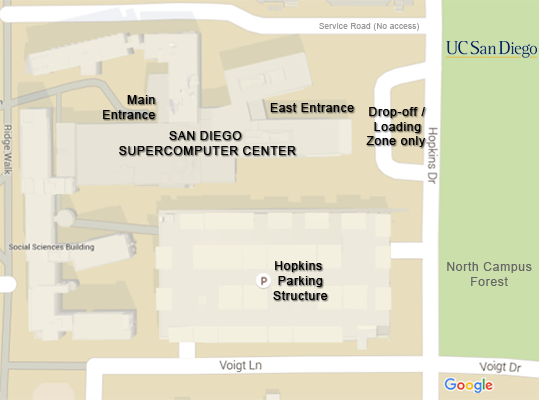
Directions to SDSC Auditorium Arrive from Hopkins Drive, walk up toward outdoor staircase at the East Entrance, but do not go up. The auditorium is located on the street level floor of the building, to the left of those stairs.
Check the following websites for direction to SDSC:
Taxis, Rideshare, and drop-off: San Diego Taxi Information maintains a list of taxis with rates and additional information. Uber and Lyft are also well established in San Diego and now have access to service San Diego’s airport. Set your destination to “9836 Hopkins Drive, La Jolla, CA 92093”
Shuttle: Shuttle service between San Diego airport, your hotel, and UCSD can be requested from SuperShuttle San Diego SAN Airport (Cloud 9 Shuttle). Yellow Cab of San Diego. Please consult their websites to find the current fares and conditions. Complimentary shuttle service from hotel to UCSD/SDSC is also available from certain La Jolla hotels.
Trolley and Bus: Lower cost alternatives to UCSD are available via the San Diego Metropolitan Transit System (MTS) buses and the trolley. Consult the Online Transit Information System Trip Planner for customized route options. Please be advised that the punctuality of the buses cannot be guaranteed due to lateness and delays. The nearest trolley station is the UCSD Central Campus Station on the Blue Line Trolley. In both the case of trolley and bus, a short 15-20 minute walk is required to reach SDSC. Consult trolley map and schedules and bus map and schedules for general details.
Driving onto campus: Driving your car onto campus is not recommended because of the scarcity of visitor parking spaces and the high price of parking for the day. If you do drive in by car, the most convenient parking is in the Hopkins parking structure at Hopkins Dr and Voigt Dr, just south of SDSC.
Parking Permits: Parking permits are required to park on UC San Diego Campus. Parking legally is the attendee’s responsibility. With a permit purchased on the ParkMobile app (Zone 4752) or a kiosk-purchased parking permit, you can park in any White “ V ” Visitor spaces only, unless otherwise indicated. Visitor Parking is limited, especially if arriving after 8am (if Hopkins is full, Pangea Parking Structure is the nearest parking alternative within walking distance to SDSC). Visitor Parking permits are currently $36 per day. The penalty for an improperly parked car is at least $80 per day. We cannot be held responsible for citations issued for parking in an incorrect space or improperly purchased permit, and the appeal process is very time consuming. UCSD Transportation and Parking Services has information about on-campus parking.
For transportation concerns, general questions and help before the workshop, ask in the Mattermost channel.